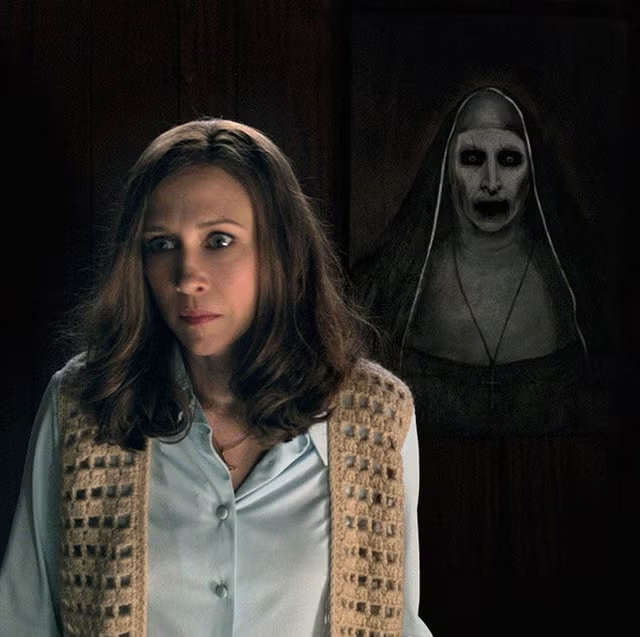
Horror films shape audience expectations long before the opening scene. Viewers usually anticipate fear, tension, and a struggle between ordinary people and some kind of unnatural threat. They expect dark spaces, unsettling sound design, and moments where they feel forced to look but also want to look away. The Conjuring and Midsommar both respond to these expectations but twist them in very different directions. The Conjuring uses a familiar haunted-house structure to deliver sharp scares and a clear battle between good and evil. Midsommar, by contrast, sets almost all of its horror in bright sunlight and slowly exposes a community whose rituals are more terrifying because they feel disturbingly calm and justified. Together, the two films show how horror can either comfort audiences with recognizable patterns or disturb them by breaking the rules they think they know. The subjects and settings of the films immediately suggest two different kinds of horror. The Conjuring centers on the Perron family, who move into a rural farmhouse where a demonic presence begins to torment them, prompting paranormal investigators Ed and Lorraine Warren to intervene. The house itself becomes a character: its basements, wardrobes, and shadowy corners provide spaces where the supernatural can hide and attack. Midsommar follows Dani and her friends as they travel from the United States to a remote Swedish commune to witness a midsummer festival. Instead of dark hallways, the horror unfolds in wide open fields, flower-filled meadows, and communal buildings bathed in sunlight. The Conjuring is about an unwanted force intruding into a family’s home, while Midsommar is about outsiders walking willingly into a community that slowly consumes them from the inside.
The filmmaking styles of the two movies guide the audience to “read” them in different ways. The Conjuring’s modus legendi is rooted in classical haunted-house language: creaking doors, flickering lights, night-time exploration, and a visual emphasis on unseen things lurking just outside the frame. The camera glides through the house and often lingers on empty spaces, training the audience to anticipate that any quiet moment might explode into a scare. Its symbols are straightforward: crosses, clocks stopping at a fixed time, bruises on the body, and the physical presence of the Warrens’ haunted artifacts. Midsommar’s modus legendi relies on ritual, symmetry, and repetition. The film repeatedly shows runic symbols, ritual circles, and choreographed communal activities, teaching the audience that everything in the village is governed by a belief system that will eventually demand sacrifice. Viewers are invited to notice small changes—like Dani’s isolation in group shots, the way the villagers mirror each other’s emotions, or the increasingly disturbing rituals—rather than waiting for a single monster to appear.
Visual techniques in The Conjuring reinforce a mood of dread and accelerate the pace during key moments. The film frequently uses low-key lighting, creating shadows that hide fragments of the demonic presence. Long takes track characters as they move through the house, building tension before cutting quickly for jump scares. The sound design—sudden bangs, whispers, and silence just before an attack—sets expectations that something terrible is about to happen. In Midsommar, light is weaponized instead of darkness. The constant daylight flattens time and makes the festival feel endless, while bright colors and symmetrical compositions create a false sense of safety. When the story becomes more violent, the camera sometimes distorts perspective and the editing slows, making the audience feel trapped inside a dream that has turned into a nightmare. Instead of signaling scares with darkness and loud sounds, Midsommar’s “breadcrumbs” come from small visual and ritual details that suggest the group will never return home.Each film turns on a pivotal moment when its core message and character arcs become unmistakable. In The Conjuring, a key turning point occurs during the climactic exorcism in the basement, when the possessed mother is restrained and Ed attempts to expel the demonic force that wants her to kill her children. The cramped space, aggressive camera movement, and chaotic cutting make the scene feel like an all-out battle for the family’s survival. This moment crystallizes the film’s belief in sacrificial love, faith, and the possibility of deliverance even in the face of pure evil. In Midsommar, the decisive moment arrives near the end when Dani, crowned May Queen, is asked to choose the final sacrifice. Surrounded by cheering villagers and wrapped in flowers, she selects her boyfriend as the victim who will be burned in the temple along with other bodies. Her calm, almost resigned expression, contrasted with the screaming inside the burning structure, reveals a shift from helpless grief to a disturbing sense of belonging. The pivotal scenes show how The Conjuring affirms family and moral order, while Midsommar suggests that a broken person can find comfort even in a violent, oppressive system.
Comparing The Conjuring and Midsommar shows that horror does not have one fixed style, even if audience expectations start in similar places. One film uses darkness, demons, and religious imagery to deliver a fast, frightening story that reassures viewers that evil can be confronted and contained. The other stretches horror across bright days, slow rituals, and psychological breakdown, leaving viewers unsettled about what “healing” and “home” can mean. By looking at how each movie constructs its subject, style, symbols, and crucial turning point, it becomes clear that horror is not only about making people jump in their seats; it is also a way to explore grief, power, and the need to belong, even in places where that belonging comes at a terrible cost.
Provide Feedback