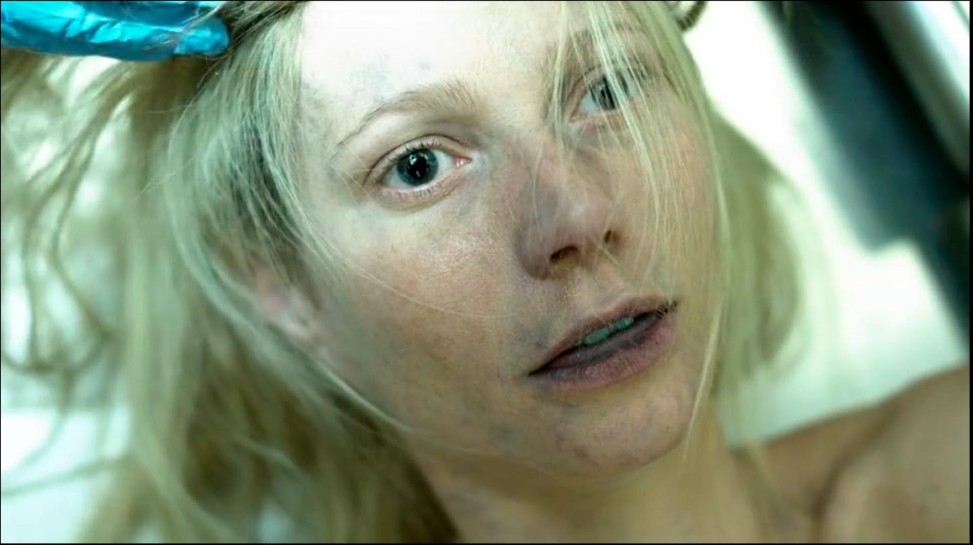
Contagion tells its story in a way that feels scattered on purpose, moving quickly from one place to another Hong Kong, Minneapolis, London, Geneva almost the way a virus jumps from person to person. This fractal, hyperlink structure makes the audience feel how connected the world is, and how a small event in one country can create a crisis everywhere else.
By not having one main character, the film shows that pandemics are shared problems, shaped by travel, technology, and global trade. The movie also uses a documentary-style realism to make everything feel believable. The lighting is natural, the camera moves quietly, and the actors play their roles with a calm seriousness. The science scenes at the CDC and WHO feel like you’re watching a real news report. This style makes the danger feel closer and more real.
The film also shows how misinformation spreads like a second virus. The character Alan Krumwiede represents this problem. His lies about a fake cure travel across the internet faster than the disease itself. This mirrors real life, especially what we saw during COVID-19 when conspiracy theories and false information spread online every day.
Globalization is another major theme. The virus begins with deforestation and corporate expansion in China, but the response is led mostly by Western institutions like the CDC and WHO. This shows both the benefits and inequalities of our global system: we are connected enough for diseases to spread quickly, but also connected enough to build vaccines and coordinate responses though the people with the most power are often in the West.
In the final scene, the film reveals the virus’s origin in a simple chain bulldozers disturb bats, the bats infect pigs, and the pigs reach a restaurant. This moment highlights how human actions, especially environmental damage and global business, can create new diseases. The film offers a quiet warning: if we continue to push into natural spaces without thinking, we may create the very crises that later terrify us.
Tadiwanashe Machana
For your analysis of the Contagion film I like the way in the beginning when you said ” story in a way that feels scattered on purpose, moving quickly from one place to another Hong Kong, Minneapolis, London, Geneva almost the way a virus jumps from person to person” showing the way it was affecting people around the world i had not considered it its quite creative. Some of the critiques you mention are the fractal structure and the hyperlink structure. I like how you connected the audience to the world and how a small event in one country can create a crisis everywhere. Another critique you listed is that it’s a documentary-style realism. Another thing I found interesting is when you linked the science scenes at the CDC and WHO to realism, as it shows how watching those scenes feels like you’re watching a real news report, and it plays into that. Another critique you stated is Globalization and Deforestation, and I like the way you like deforestation as taking part in causing the virus.
dibeshwar routh
Characters Across the World, One Contagion (Steven Soderbergh)
This entry has appropriately discussed the most significant requirements of media analysis, as it discusses the narrative structure, film style, and thematic issues clearly and effectively. The description of the hyperlink structure is particularly powerful; it helps to understand how the movie reflects the viral phenomenon with its fast changes of place and point of view. There is also the emphasis of realism as achieved by the use of natural lighting, relaxed acting, and the use of documentary-like camera work that demonstrates good consideration in terms of the formal techniques. The focus on how globalization brings vulnerability as well as cooperation was one of the elements that were new to me. The debate on Western institutions being in charge of response, even though the outbreak took place in other areas, provides a curious twist concerning the global inequality that I had not thought of before. The chain of environmental origin presented in the end also provided a renewed insight into how human growth can inadvertently become the source of pandemics. Although the analysis is well-elaborated and easy to grasp, it could be improved by providing more specific examples related to the scenes or characters to support certain statements.