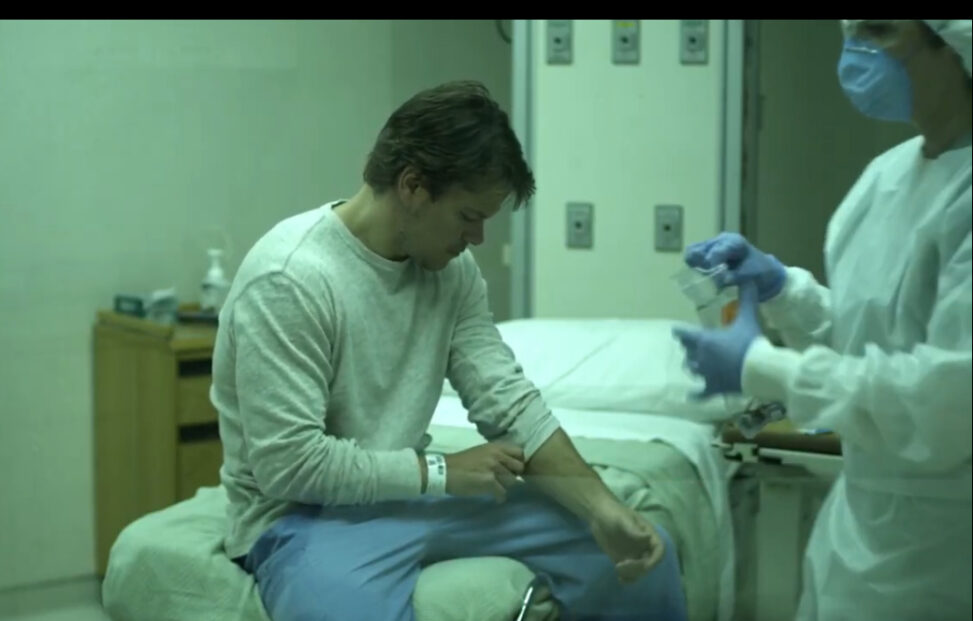
Contagion shows how a global pandemic spreads and how the world responds to it using a unique storytelling style and a strong sense of realism. Instead of focusing on one main character, the movie follows many people in different countries, including doctors, government officials, and regular citizens. This structure showcases how a real virus spreads quickly, randomly and across borders. Small actions, like a handshake or touching a surface, lead to massive global consequences. This helps show how connected the modern world is.
The film feels realistic because of its documentary-style approach. The director avoids drama and instead shows science in a careful and detailed way. Hospitals, labs, and government offices look natural and realistic. Scientists use real procedures such as contact tracing, testing, and vaccine development. Because everything is shown as slow and uncertain, the pandemic feels real and frightening, like something that could actually happen.
The movie also jumps frequently between different countries and characters, which is known as a hyperlink narrative. This can make it harder to emotionally connect with one single character, but it helps the audience understand how big the crisis really is. We see that the virus is not just a problem in one place as it is affecting the entire world at the same time. This keeps the viewer engaged and reinforces the idea that in a global crisis, no one is safe.
Contagion is similar to other films that use multiple connected storylines to show global problems, such as Traffic, Babel, and Syriana. These films all show how problems cross borders and affect many different people. What makes Contagion stand out is that the connecting force is not politics or culture, but a virus. The disease becomes what connects everyone.
The film also reflects ideas about globalization discussed by Roland Robertson and Kathleen White. Globalization in the movie is shown as both helpful and dangerous. International travel, global business, and crowded cities allow the virus to spread extremely fast. At the same time, globalization allows scientists around the world to share information and work toward a vaccine. Overall, the film shows globalization as more harmful than beneficial because the damage spreads faster than the solution (Robertson & White).
Although the virus starts in China, most of the global response in the film is led by Western organizations such as the Centers for Disease Control and Prevention and the World Health Organization (WHO). Western countries are shown as the main leaders and problem-solvers. Other regions are mostly shown as the source of the outbreak or as places being helped, rather than equal leaders in the response.
The military also plays an important role in the film. Soldiers are shown helping to control crowds, protect vaccine shipments, and maintain order when society starts to break down. The military is not shown as aggressive, but as a tool used by the government to manage chaos when regular systems fail. This suggests that during extreme crises, force and control become necessary to keep society functioning.
The ideas in the film also connect to Mark Harrison’s book Contagion: How Commerce Has Spread Disease. Harrison argues that global trade and business have historically helped spread diseases. In the movie, international travel and global business allow the virus to move quickly from one country to another. The shows that modern commerce makes pandemics harder to control (Harrison).
The final scene of Contagion clearly links the virus to environmental destruction. The film shows that deforestation caused by corporate development forces bats out of their natural habitat. A bat drops infected fruit into a pig farm, and the virus eventually reaches humans. This ties the pandemic to human damage to the environment. The film sends a warning that when humans interfere too much with nature for profit, there can be deadly consequences.
The film also criticizes capitalism and corporate greed. This is shown through characters who spread false cures to make money. Contagion shows how profit is often placed above public safety. However, its critique is subtle. Instead of focusing on one evil corporation, it shows how everyday business and media systems can quietly contribute to global disaster.
In conclusion, Contagion uses multiple storylines, realistic science, and global settings to show how a pandemic spreads in a connected world. The film presents globalization as both necessary and dangerous, but also harmful. It highlights Western dominance in global crisis response, shows the military as a tool for control, and connects the outbreak to environmental destruction and corporate greed. Together, these elements show that pandemics are not only medical events, but also political, economic, and environmental disasters shaped by human behavior.
References
Harrison, Mark. Contagion: How Commerce Has Spread Disease. Yale University Press, 2012.
Robertson, Roland, and Kathleen White. Globalization: Social Theory and Global Culture. Sage Publications, 2007.
Tadiwanashe Machana
The critique that is stated in this analysis is realism and I like how you show that they were many characters affected like in different countries, including doctors, government officials and regular citizens however, you never stated the critique that was being referenced, which is hyperlink narrative. You also discussed that it’s a documentary style critique, and I appreciate how you stated that the director avoids drama and instead shows science in a careful and in a real way, which is linking it to a documentary style approach later on you do state the hyperlink narrative, especially showing how the movie was jumping frequently from different countries and characters. Another critique that you stated is globalization you also showed how it can be helpful and dangerous. Another thing that you showed in this film was that it was a western centric view even though you didn’t state how you came to the idea when showing the Western organizations like CDC and WHO are the main leaders in other words you didn’t link it. You also did state the military played a part in the film you showed how they tried to help control, protect vaccine shipments and maintain order. You even showed how they do not do it in aggressive tone but try to maintain the chaos. Another critique that you stated is the environmental destruction I like how you showed deforestation is a root that developed the bats from being forced out of their natural habitat, and start to infect people and animals another thing you stated is corporate greed, and I agree with how you linked it with the characters who was spreading false cures in order to make money, even though you did state it was subtle in conclusion you listed a lot of critiques which were thoroughly explained, and I was able to follow what you were saying.