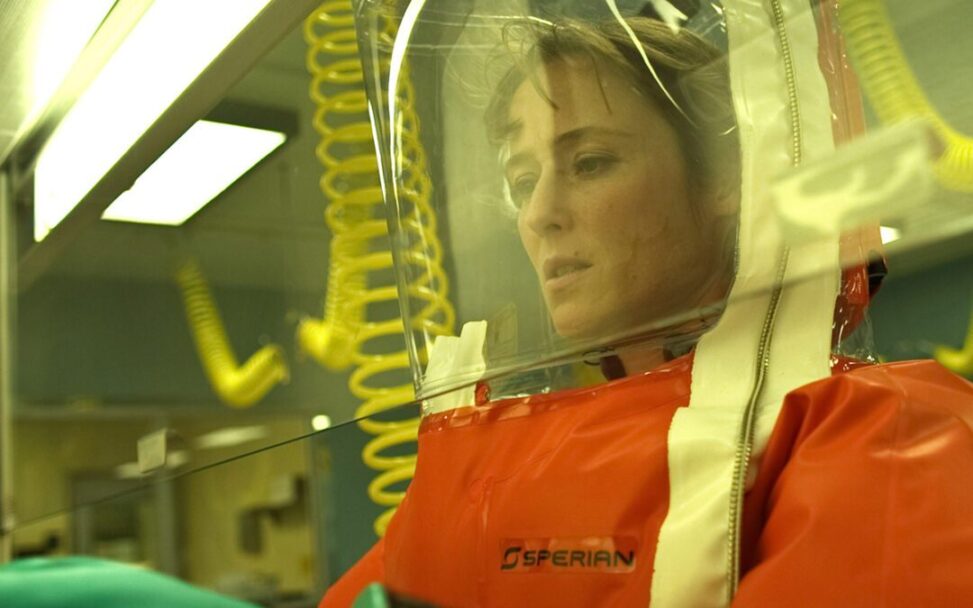
Contagion uses a restrained and observational style, that is similar to documentary film making. Handheld camera work, lighting, little background music, and scenes that focus longer on medical procedures and lab work. The dialogue is very specific scientific language but is delivered in a less theatrical type of way. This then creates an impression that viewers are watching a real response to a crisis rather than just scenes in a movie. All the realistic parts of this movie are supported by the help of real medical experts and the CDC, giving all the procedures in it a sense of authenticity. This documentary style film shows that pandemics can emerge from everyday systems, not conspiracies.
The hyperlink narrative jumps between scientists, families, doctors, government workers, and people around the world. This shows how connected people are through the pandemic. Instead of focusing on one main person, the movie constantly switches from people’s perspectives of the pandemic to show how the disease affects everyone in different ways. This also keeps the viewers interested because of the constant switching. The switching also shows how the virus spreads unpredictably, moving across borders and continents. With this style of filming, viewers might feel less of a connection because there is no main character, but the filming style captures the real size and effect of the outbreak on the world.
The movie often repeats patterns like fear, infection, and response. This shows how a virus moves from a small issue to a worldwide pandemic. Similar to other movies like Babbel, Traffic, and Syriana, Contagion uses many linked storylines to show the spreading of the virus to show that it can’t be understood from one single point of view.
The final scene connects the virus to ecology by showing the deforestation forcing animals out of their habitats. This leads to the virus going from bats to pigs to humans. This scene shows viewers what the consequences of messing with nature could be.
The film definetly warn people about the risks of expansion and how it could lead to another global pandemic. The forest was cleared by a large company, showing how development that is focused on profits can endanger our world. Like most films that are focused on the environment, Contagion shows the risk that large corporations can cause.
The spreading of misinformation throughout the film shows how media clips, social networks, and simple conversations can spread similarly to a virus. The film jumps between characters and locations, creating a sort of layered story that feels like navigating through multiple feeds at once.
The film critiques the internet through Alan Krumwiede in a few ways. Krumwiede uses social media to post videos that spread false cures and create fear. This shows how spreading misinformation on social media platforms can create unnecessary fear and amplify the seriousness of the situation.
The film mirrors real world conspiracy theories by showing how people believe in fake cures, don’t trust scientists, and think that the government is hiding things from them, very similar to the reactions during Covid-19.
The filming creates immediacy and authenticity by using handheld shots, natural lighting, realistic settings that make the movie feel fast, real, and like a documentary.
The movie shows the tension in globalization by demonstrating how global travel can spread the virus while western agencies and media dominate the story. Globalization is shown as both good and bad. It’s looked at as bad for how it helps the virus spread, but good for how it helps with worldwide cooperation to create a cure as fast as they can.
The response to the virus is definitely western-centric. The virus starts in China, but the CDC and other western experts lead the investigation and solution, meaning the movie reflects a western point of view.
The movie mostly reinforces Hollywood’s global influence by putting western science and institutions as the center of the narrative.
ALINA KC
The analysis clearly meets the criteria by linking Contagion’s documentary style and hyperlink narrative to themes of ecology, power, and globalization. It does a good job explaining how realism and multiple viewpoints show pandemics as systemic rather than conspiratorial. However, it tends to repeat points about handheld cameras and realism instead of pushing the argument further. The strongest ideas are the reading of deforestation as ecological critique and the point that globalization is shown as both dangerous and necessary. The paragraph on misinformation and Alan Krumwiede is also effective, but it could connect more directly to power structures (who benefits from panic, who is harmed). Overall, the piece is insightful but would be stronger if it went deeper into questions of inequality and Western dominance instead of mostly describing what the film shows.